

Our Table: A trip back in time to ensure our future
Our Table’s farm is now 100% solar-paneled
By Diana Page Jordan
SHERWOOD, Ore. — An innovative food production business that has its roots in the past has grown up on 60 acres in Sherwood. Our Table is a cooperative, tucked into the winding Southwest Morgan Road.
Our Table Founder Narendra Varma said, “Both my wife Machelle and I are super interested in what I call the holy nexus between food and community. That's what drives this. Our motto is building community through food.”
A former high-tech worker, Varma said, “We felt very strongly that we wanted to experiment around relocalizing the food system. The food system, over the last 100 years, has become all about very large companies, with no connection between the people who eat the food and where it comes from.”
That led the Varma family to move from Seattle to Oregon in 2010, drawn by this state’s land use laws that stringently protect farmland. The farm is in the greater Portland area, on the outskirts of Sherwood Town, and, for many, within walking distance, an appealing location for the Varmas. They launched the Co-op in 2013.
Varma said he doesn’t think that food can be reduced to its nutritional components.
"It's bigger than that," Varma said. "So much of food is about culture and your mental state."
He quotes research that shows that your body absorbs more nutrients when you eat a meal with others than it does when you eat that same meal alone.
At the same time, Our Table is 100% organic. There are no chemicals, no GMOs, no additives. Varma said,
"We also don’t till at all, which creates healthier soils, captures more carbon, all of that," Varma said.
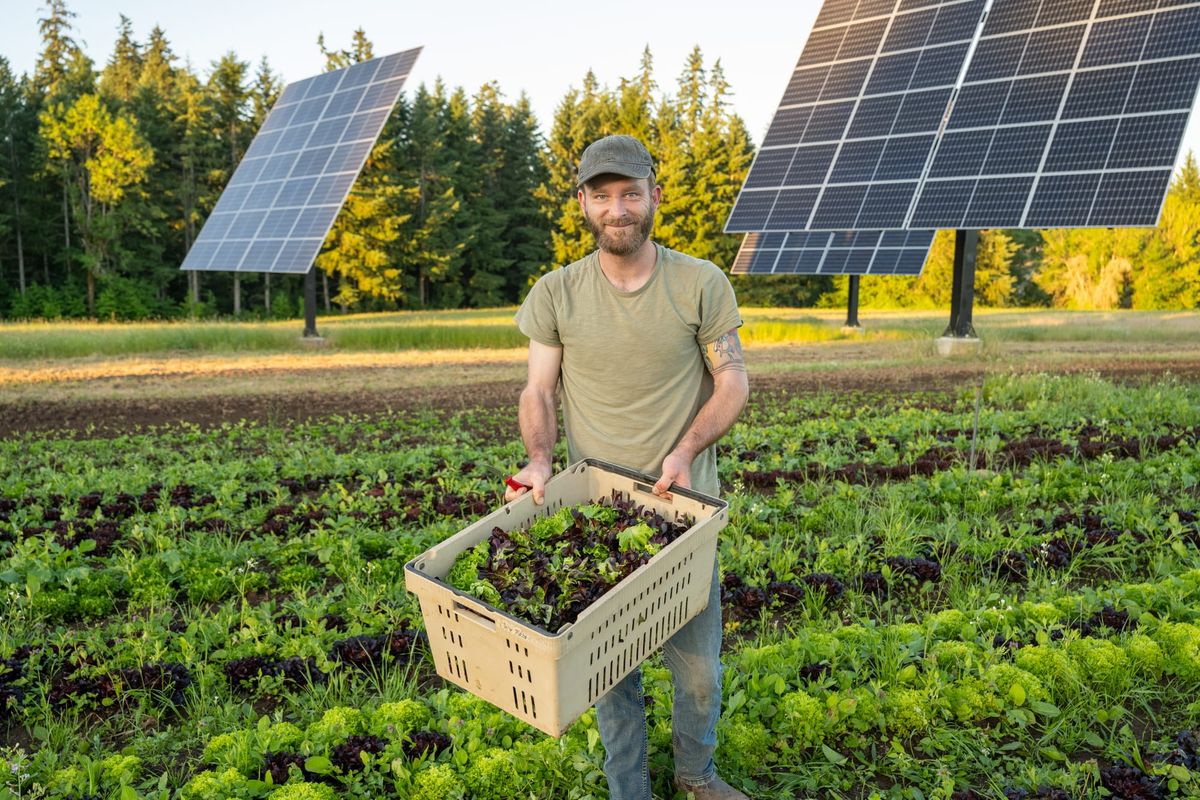
Our Table’s farm is also 100% solar paneled. The solar panels generate all the energy for the farm, including shade for the crops that like shade. All the delivery vehicles are electric, so the farm can be fossil fuel free as well.
“We work very, very hard to source as clean a food as we can, with the assumption being that if you eat clean, you are more likely to not have food related diseases,” he said, adding that they also focus on the future by tying in with schools and children’s education.
The farm produces up to sixty different kinds of vegetable varieties, which is the primary product. Varma said they’re mostly known for their blueberries, producing more than twenty tons of blueberries a year. Those are sold throughout the Portland Metro area only.
They also produce raspberries, strawberries, and a few other things, including tree fruit, and both ornamental and cut flowers. They don’t have livestock here, but they do have honeybees and honey. When it comes to meat and grain, those are produced by members whose farms match Our Table’s growing practices, values, and ethical standards.
Their commercial kitchen runs on weekdays, as does farm work. The weekends are more retail oriented. There are about 20 employees out in the fields and in the shop. The store is only open Thursday through Sunday, where the products include fresh food and prepared foods, basically using home recipes. There is also local beer and wine.
“We don't have a huge amount of gifts and things like that, because that's just not what our focus is,” Varma said. “Things like olive oil, you can't really get here. Some things you have to get further afield. You could argue coffee and chocolate are the same way. They might be produced by local chocolatiers or coffee roasters, but eventually the beans were grown somewhere else, right? So those things get a little complex.”
As for entertainment, Varma said they offer community gatherings around food.
"Once a month in the summertime, we do a pizza night. We also do farm dinners, some private events, and some ticketed events," Varma said. "A lot of the private events tend to be corporate kind of things."
Our Table values public engagement, so, as Varma said, "People come. They grab some food. They sit around or just hang out. It is open to the public, in that sense, while the store is open."
Varma said his hope for the co-op is to support the community and to be profitable, perhaps expanding to other local towns.
“It is my dream that people grow more of their own food, especially people in suburbia who have space. If you have a backyard and a front yard, grow some food, stick a tomato plant in the ground," Varma said. "It's fun. You get your hands in the soil a little bit — you connect. It's good for your health. And you save money.”
His dream goes deeper than that.
“The more people who get involved, the more you get a healthy society. I truly believe that health starts with what you put in your body," Varma said. "I would like to see a lot less pharmaceuticals in the world and a lot more healthy food in the world. That is my big dream.”