



TriMet could cut Sherwood’s Line 97, proposes alternative route coverage
TriMet meets with Sherwood leaders on Line 97 elimination and possible replacement plan amid $300M deficit
This article has been updated.
SHERWOOD, Ore. — TriMet’s bus Line 97 through Sherwood could be eliminated according to a budget proposal, but it’s possible some of the route could be added back by a different bus.
Sherwood city officials met with TriMet on Tuesday, February 3 to discuss proposed changes to bus routes in the city, including a new proposition to save some of Line 97’s service route.
“We want to talk with you about the proposal we made at the beginning of this year and how we are taking some of that feedback to see if we can mitigate some of those issues that you have,” said John Serra, regional government affairs manager with TriMet. “Obviously not all of them, we still need to make cuts to address our budget crisis.”
This comes after TriMet proposed service reductions to the Sherwood area, including eliminating bus Line 97, which provides weekday connections between Sherwood Plaza and the Tualatin WES Commuter Rail Station. Other nearby routes could also see significant changes and affect connections, but no changes were initially proposed for Sherwood’s Line 94.
“Service cuts are always our last resort. However, we need to reduce spending to close a projected $300 million annual budget gap — and avoid a fiscal cliff that would have devastating effects on transit service,” said Mark Miller, spokesperson with TriMet. “Taking action now will stabilize TriMet’s finances, so we can continue providing reliable, quality transit service for years to come.”
TriMet cited low ridership and a $300 million annual gap between revenue and operating costs.
“We’ve proposed this change due to low ridership on Line 97, which runs only on weekdays at peak commute times,” Miller said. “Most of Sherwood’s bus service is provided by Line 94-Tigard/Sherwood, which runs every day from early in the morning until late at night.”
If the changes go through, that would mean longer commute times and more transfers for Sherwoodians who use TriMet’s public transport.
There were open houses and a public comment period throughout January.
“We’re encouraging people to learn about these changes and share any feedback they have by taking an online survey,” Miller said. “We have also been holding open houses in January, including one recently at the Tualatin Public Library, to share information, answer questions and listen to feedback.”

TriMet’s proposal to save Line 97
Tom Mills, TriMet’s director of planning and policy, said no single method methodology is going to solve the whole problem, because TriMet is looking at a 10-15% cut to save money.
“Most relevant to Sherwood, there were three lines that were recommended to be eliminated because of low ridership,” Mills said. He said TriMet is looking at cutting midday routes and late-night frequency.
Since part of TriMet's revenue comes from rider fares, the net cost of providing service that few riders use is generally higher than providing service that has higher ridership, Miller said.
“We’re not getting the same kind of ridership; people are working from home, they’re not going downtown anymore,” Mills said.
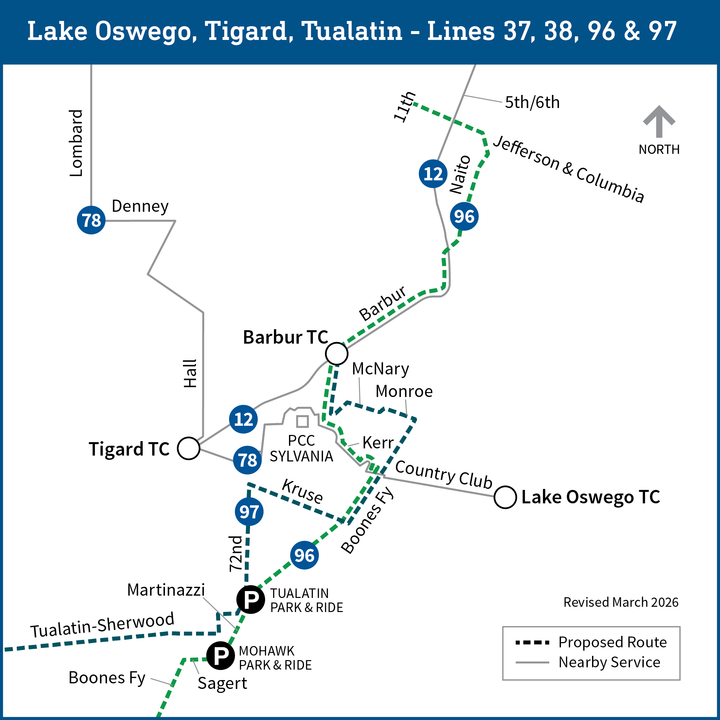
To save transit along Line 97, Mills said TriMet could use Line 38 to service some of the same route. He also proposed reducing the frequency of Line 94 to run every 30 minutes instead of every 20 minutes.
“The issue we run into in suburban areas is really a land use issue. People are more spread out, so it’s harder to group people into a bus,” Mills said.
TriMet’s final proposals are slated to roll out on March 11 and head toward approval by TriMet’s board of directors, according to Miller.
TriMet’s funding crisis
JC Vannatta, TriMet’s chief of public affairs, said ridership is down 30% since pre-pandemic levels, due to layoffs, remote working, and public safety concerns. That’s a $60 million drop in fare revenue due to decreased ridership, he said.
There has also been a record enrollment increase in low-income riders, who qualify for a half-priced fare rate. TriMet is also planning to increase fares if its board approves it.
“Our costs have skyrocketed 56% in the last five to six years, and that’s due to a number of reasons whether it’s labor, gas, electricity bills,” Vannatta said. “We have about a $300 million structural deficit that we are trying to solve by July 1, 2028. Good government practices say if you know about a shortfall, a fiscal cliff, fix it within three years. So that’s what we’re trying to do.”
TriMet has identified three areas to cut to save $93 million in spending, and is hoping to earn $48 million a year from a transportation package, House Bill 3991, which was delayed, proposing new taxes and fees.
“We've already reduced spending by $150 million through efficiencies: we’ve canceled some future planned service increases; we've eliminated positions with layoffs,” Vannatta said.
TriMet already eliminated 68 largely vacant positions, including 26 layoffs last fall, according to Miller.
City response
“The City is aware of TriMet’s proposal to eliminate one of the bus routes serving Sherwood, which many residents rely on for work, school, and other essential travel,” said Sherwood City Manager Craig Sheldon. “We understand the concern this proposal has generated and take those concerns seriously.”
Sheldon said the Feb. 3 work session was intended to better understand the factors behind the proposed changes, review ridership and service data, and discuss potential alternatives to reduce impacts on Sherwood.
“The City’s priority is to ensure that the needs of our residents are clearly communicated and considered in TriMet’s decision-making process,” Sheldon said.
Mayor Rosener said the city is having tough conversations with TriMet about what this means for Sherwood, taxpayers, commuters, and transit services.
“We’ve had some great concerns about the cuts,” Rosener said at the February 3 meeting. “If the state bails you out, I would like to see a fundamental shift in how TriMet thinks about transit and how it is organized. It doesn’t happen overnight; I understand that, but we have to start working toward a different mode and a different way of thinking about how people use transit because this mentality we have today is just not working.”