



Sherwood City Council Recap | Feb. 17, 2026
City Council talks Washington County housing report, Oregon legislature housing bills
SHERWOOD, Ore. — The Sherwood City Council met Tuesday, Feb. 17 for its regularly scheduled meeting following a work session.
Mayor Tim Rosener, Council President Kim Young, and Councilors Keith Mays, Dan Standke, and Renee Brouse were all present. Councilor Taylor Giles attended virtually, and Councilor Doug Scott was absent.
The council discussed the Washington County Housing Department’s annual report, incentives of the Old Town Strategic Plan, and proposed state legislation on housing bills.
The council unanimously approved the January 13 election returns, which expanded local control over land use and housing development policy, challenging state law.
They also unanimously approved an agreement between the city and its employee union, extending the current bargaining agreement through June 30, 2028.
After the meeting, the council adjourned to executive session to discuss a property transaction.
Council Updates
Standke said many residents wrote in about Governor Tina Kotek’s February 5 letter to Homeland Security, which was signed by 31 mayors. It demanded an immediate halt to federal immigration enforcement actions in Oregon until all federal use-of-force incidents are fully investigated.
“Their messages were thoughtful and heartfelt, and they reflect a deep concern for the safety and well-being in our community, and I want to acknowledge those voices tonight,” Standke said. “The letter … responds to a series of alarming actions by federal immigration officers including lethal force in Minnesota and violent incidents here in Oregon. It explains those tactics are eroding public trust, undermining civil liberties, and creating fear among families who are simply trying to live their everyday lives. It describes parents afraid to take their children to school, families avoiding healthcare, and workers staying home. The sanctuary portion of the letter resonates with the values I'd like to see Sherwood uphold.”
He said Oregon’s sanctuary law has been in place for decades with bipartisan support, ensuring federal immigration enforcement remains federal while local officers stay focused on keeping neighborhoods safe and addressing local criminal activity.
“Sanctuary protections do not give anyone a free pass on crime,” Standke said. “Many residents also raised concerns about how federal enforcement has been carried out. Recent reporting and multiple lawsuits have alleged racial profiling during federal immigration actions this year, including suspicionless stops and warrantless arrests targeting Latino residents, including U.S. citizens. This is important context because Oregon's original sanctuary framework was created to prevent exactly that kind of racial profiling and to preserve the trust between communities and local law enforcement.”
Standke said trust helps citizens report crimes, seek help when needed, and participate fully in the community.
“That sense of safety and connection is something that I want for Sherwood and something I believe strengthens our city,” Standke said. “The letter also offers a simple yet powerful message that we stand with our immigrant and refugee communities. You belong here. That message is humane and reflects the values I believe Sherwood strives to uphold.”
Old Town Plan
Eric Rutledge, City of Sherwood community development director, presented on the Old Town Strategic Plan, highlighting initiating a financial strategy such as considering adoption of a local improvement district, initiating programs and grants, and streamlining the review process.
Financial actions could include activating and refreshing the Old Town Facade Grant program with updated guidelines and streamlined applications; permit fee relief for targeted uses and long-vacant spaces; and launching alley activation mini-grants for lighting, paving, murals, and shared trash to enhance safety, uses, and aesthetics.
Non-financial actions could include simplifying small-scale improvements like creating a quick permit pathway for minor upgrades like paint, signage, and windows, and designating a business liaison from city staff.
“These would be opportunities that would likely require … a follow-up action from the city council,” Rutledge said. “The plan gives actions you can take, and once the fund is adopted, we come back for an implementation work session and start talking about what the city council has as a first priority.”
Councilor Scott said he’s on board with some of it so far, and sees value in the permit fee relief and alley activation.
“I'm looking at this as this whole strategic plan is strategic and trying to move the Old Town forward in what eventually becomes a transformative way,” Scott said. “(Bringing in new businesses and alley activation) are the ones that, to me, feel more transformative, more like we're driving towards a longer-term vision that's strategic.”
Rutledge also presented on how the city can opt to participate in leveraging grants and state or federal funds, and increase vertical housing by offering property tax exemptions on vertical residential floors to improve project feasibility.
The City Council plans to continue to finalize the plan before later voting on specific actions, such as developing an infrastructure and funding plan.
Public Comment
In public comment, spouses Brad and Ann Brucker spoke about renovating 16017 S.W. First St., where Ann’s business Mosaic Arts Loft is located. They said they are in favor of the Old Town Strategic Action Plan.
“It’s a big task for anyone as small as us,” Brad said. “We replaced that entire old tin rickety wall that’s been there for about a hundred years. It was very unsightly, and it is right in the heart of Old Town. Our heart is to enhance Old Town. We’ve done a lot out of pocket, but we could use a little help.”
Brad said they want to replace the facade, and already submitted the application to do so, but they don’t have the money for it.
“Any help we can get with that would be wonderful,” Brad said.
Rosener said he wanted to meet with them again to help them find out about every program available.
“I can’t tell you how much we appreciate your commitment to Sherwood and all the work you’re doing to help revitalize and make it even better,” Rosener said.

Housing Services Report
Liz Morris, rental assistance division manager with Washington County, and Megan Cohen, supportive housing services liaison, preseneted to the council an annual report on housing solutions.
“Since January of last year, we’ve had three brand new shelters come online — Beaverton, Hillsboro, and Tigard — which has added 195 permanent, year-round beds to our system, which is absolutely incredible, and the demand is even higher,” Cohen said. “For every 10 folks that we’re housing, 14 are becoming unhoused.”
She said every single shelter bed in Washington County is full, with waitlists stretching months.
“At the point somebody becomes homeless, there’s no quick, easy entry into shelter, and that’s creating a lot of challenges in our system,” Cohen said. “We’re also seeing a lot of families struggle with housing affordability."
She said changes to Medicaid, food stamps, and increasing prices exacerbate that struggle.
“We’re really lucky to have really great local resources here — the number of (free food) pantries you have in Sherwood is incredible,” Cohen said. “But there are key things we are missing, such as eviction prevention, which is pretty much gone at this point.”
This comes after the state cut more than 70% of eviction prevention funding in the last legislative session when it passed the final budget last summer.
“One of the biggest populations that we’re seeing impacted are seniors. Seniors who maybe paid off their mortgages, and are now on fixed incomes, but because of the cost of everyday things, we’re seeing 80- and 90-year-olds in our shelters who are homeless for the first time,” Cohen said. “It’s really challenging and really sad.”
According to the county’s report, 940 people in Washington County were experiencing homelessness during the 2025 point in time count — up more than 150 from the 2023. There were over 3,100 people served in shelters or outreach during 2024-25 — up over 800 since 2023-24. About 50% of residents are estimated to be rent-burdened across Washington County, with the median gross rent at $1,773 for 2019-2023.
“We know that the need is outpacing the impact,” Morris said.
For Sherwood, Cohen’s role is connecting with people so they know how to make critical connections to housing and shelter support. She said in Sherwood, Zillow showed 63 rental units available, but only two were listed below $2,000 — and they were a one-bedroom and a studio. This means unless the resident is making $60,000-70,000 a year, they would be considered rent-burdened — especially challenging as utility bills are increasingly charged separately.
“We’re working really hard to figure out what those resources are, and most importantly how we can make sure people know about them as early as possible so they can get on those waitlists and hopefully get those services as quickly as possible,” Cohen said.
They appreciated Sherwood’s partnership in the battle against houselessness, particularly its investment in the safe parking program, where people living in their cars can park safely and legally, and access sanitation services as well as consultations with case managers.
The report also covered goals, pathways, programs, and a financial overview.
State Legislation
Rutledge briefed the city council on three bills currently being reviewed by the Oregon Legislature in the current regular session.
“The first one is probably the most concerning to Sherwood: it’s House Bill 4037,” Rutledge said.
HB 4037 adjusts terms for local government regulating housing development, particularly concerning revolving loan programs for funding affordable housing projects.
“We’ve been talking about putting restrictions on land use regulations and public notices and public hearings,” Rutledge said. “Essentially, this would allow a local jurisdiction to only provide owners notice of land use applications for housing. The city could only provide notice to owners of record within 100 feet, no more. Our code says 1,000 feet.”
The bill also says local government doesn’t have to require a public hearing prior to making a decision on the land use applicant.
“We’ll continue to push back on this, but it’s not good,” Rutledge said.
They also reviewed HB 4128, and Senate Bill 1514.
HB 4128 would establish a 90-day waiting period after single-family residences have been publicly listed for institutional real estate investors to purchase them.
SB 1514 would repeal a bill that established public camping regulations.
City Manager Report
Craig Sheldon, Sherwood city manager, said a Sherwood broadband customer survey will go out soon, as well as a solid waste food scrap survey.
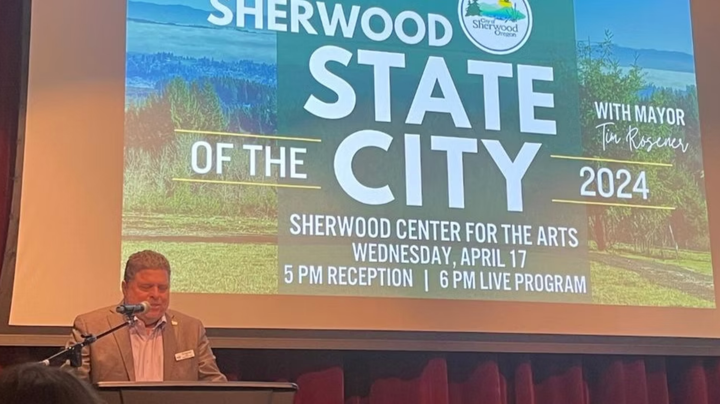
The State of the City is scheduled for Wednesday, April 15, at the Center for the Arts.
Community Enhancement Grant Applications are now open, and due April 15 at 5 p.m.
Bibliography
https://www.sherwoodoregon.gov/wp-content/uploads/2026/02/02-City-Council-Mtg-Agenda-02.17.2026.pdf
 Jules Rogers


 Bryce Dole


https://olis.oregonlegislature.gov/liz/2026R1/Measures/Overview/HB4037
https://olis.oregonlegislature.gov/liz/2022r1/Downloads/MeasureDocument/HB4128/Enrolled
https://olis.oregonlegislature.gov/liz/2026R1/Measures/Overview/SB1514